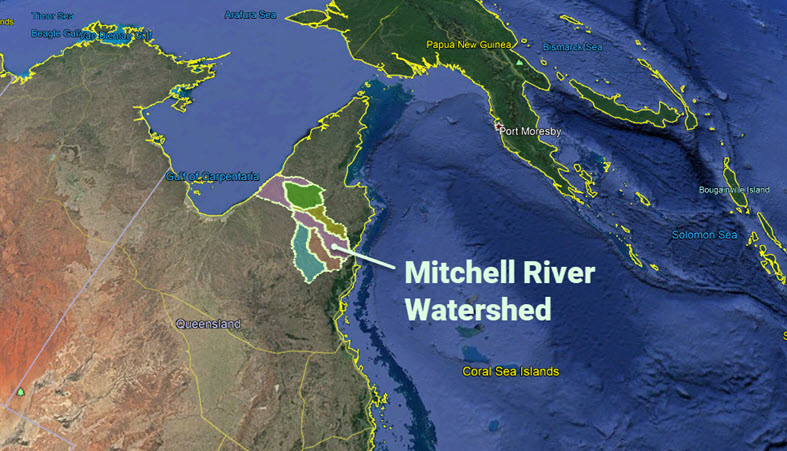
The Mitchell River catchment in Tropical North
Queensland, Australia, spans 72,000 square kilometres
(the size of Tasmania) across the base of Cape
York Peninsula. It incorporates five major river
systems: the Mitchell, Alice, Palmer, Walsh and
Lynd, and involves four local governments; namely Tablelands
Regional (formerly Mareeba), Cook, Carpentaria and Kowanyama
Communities Local Government Area.
The Mitchell River Watershed Management Group
Inc (MRWMG) arose out of a conference on watershed
management held at Kowanyama in 1990. The catalyst
for this conference was the concern for the river’s
health felt by the Traditional Owners when they
first started flying to Cairns and saw the catchment
from the air. The MRWMG, has grown into an independent,
not-for-profit organisation working in partnership
with local communities and stakeholders to:
- create a balanced approach
to the use of the catchments resources; and
- achieve sustainable and
integrated management of the Mitchell River
catchment area.
Read more about us,
our projects, news
and issues, and about
the catchment in the relevant pages of this
web site. There are also pages dedicated to education
and awareness activities for kids, a publications area
containing a collection of internal and external
reports and other documents, a calendar
of events, and details of how you can become
involved. The Mitchell River Group is also
an endorsed tax deductible gift recipient and
we greatly appreciate donations.
The Mitchell River Group is an endorsed tax
deductible gift recipient and all donations
over AU$2.00 are 100% tax deductible. We greatly
appreciate donations to help continue and expand
the projects and assistance we provide to stakeholders
in the Mitchell River catchment.
If this is your first visit to our site, please
take some time to view our Current Projects page
to gain insight on some of the community and
environmental projects we are involved in.
The About Us and About
The Catchment pages tell the Mitchell
River Group story and outline the significant
features of the Mitchell River system and
catchment area.
To Make a Donation...
Click here to access our donation page.
It offers a secure payment facility linked
to the Westpac Bank that allows credit card transactions and
provides a Tax Invoice receipt upon payment. All donations
over AU$2.00 are tax deductible.
|
New Workshops and Newsletters
See the News and Issues Page for information on recent newsletters, upcoming conferences and workshops including:
- Workshops on Regenerative Agriculture (low input sustainable)
- Queensland Landcare Conference 15 - 17 September2010 at Caloundra, Sunshine Coast.
- 13th International Riversymposium 11-14 October 2010, Peerth, WA
Regenerative Agriculture Newsletter
Over the Fence #13 - Grazing Best Practice Newsletter
Wildlife queensland launches campaign to ban opera house traps.
Wildlife Queensland is currently running a campaign to ban opera house traps and other enclosed yabby traps in public waters of Queensland due to the impact they have on wildlife such as platypus, turtles and water birds. While legal in Queensland these traps have been banned in all public waters of Tasmania, Victoria the ACT and east of the Newell Highway in New South Wales.
For more information click here.
Walsh River Catchment Management Plan - Public Consultation
Members of the community took part in two workshops at the Dimbulah Town Hall on Tuesday 27th April. The purpose of the workshops was to identify management issues of concern for the public. These issues would then be an important element in the development of an updated Walsh River Sub-Catchment plan. The workshops identified a wide range of concerns which will be incorporated into a draft sub-catchment plan for wider circulation.
People who couldn’t get to the workshop can still have input to the plan by phoning the Mitchell River Group on 40533471 or emailing: bill@mitchell-river.com.au
Celebrating the Kowanyama Native
Title Determination on 22 October and Errk Oykangand
National Park handover on 23 October 2009
The Kowanyama community was celebrating a historic native
title determination, their first ever, when
their native title rights were recognised over
about 2,731sq km of land and waters . This is
Part A of a much larger claim over a total area
of 19,800sq km and includes the Kowanyama community
and a coastal strip approximately 160 kms long
from the Coleman River to the Staaten River.
Click here for
some images of the community celebrations.
The celebrations continued
on 23 October 2009 when Climate Change and Sustainability
Minister Kate Jones visited Kowanyama to hand
back ownership of the 37,000-hectare Mitchell-Alice
Rivers National Park to the region's Traditional
Owners, the Kunjen and Oykangand People.
"This is the first existing national park to be returned to
Traditional Owners," Ms Jones said.
The former Mitchell Alice Rivers National Park,
30 kilometres north east of Kowanyama, will be
renamed the Errk Oykangand National Park.
Upper Mitchell River Catchment (Julatten-Mt
Molloy Area) Wet Tropics Habitat Restoration - Small Grants
Scheme 2010-2011
The Mitchell
River Watershed Management Group has
received further funding of $70,000 under the
Queensland government Q2 Coasts and Country program to provide grants for even more habitat
restoration work in the Wet Tropics area of
the upper Mitchell River catchment. This
funding will enable the 2008-9 and 2009-10 habitat
restoration grants schemes to be extended for
another year.
The $150,000 of grants awarded to landowners
in the Julatten-Mt Molloy corridor in 2008-10
assisted them in restoring the habitat values
of their land. Individual projects have
replanted rainforest on cleared land (including
land used for grazing and sugarcane), restored
the vegetation in riparian (stream bank) areas
and fenced off wetland areas to exclude feral
pigs. Grants awarded between December 2008
and February 2010 have, to date, resulted in
the planting of at more than 20,000 trees on previously cleared land on 20 different
properties. The efforts of landowners have
both increased the habitat value of these properties
and improved the connectivity between the World
Heritage Wet Tropics sections either side of
this valley.
You can view pictures of these projects at a Flickr site created for the project.
The 2010/11 round of grants will be awarded to landowners for projects
that make a contribution to the biodiversity of
the region through building habitat islands /
stepping stones and removing barriers to movement
of species between the protected areas of the
Wet Tropics World Heritage area. Projects supported may include the replanting of areas previously cleared for agriculture, restoration
of wetland and riparian vegetation and feral pig/stock exclusion fencing to protect wetlands or riparian vegetation along a stream, which also enhances
biodiversity in the streams of the project
area. Applicants are expected to make significant in-kind contributions in time
and resources, if not expenditure of additional
funds.
This project is supported by the Mitchell River Watershed Management Group, through funding from the Queensland Government’s Q2 Coasts and Country.
Grant application forms, an information sheet on the grants scheme, useful maps of the project area and a progress report on the project are available below. Grant applications should be made on the application form and submitted by COB on Friday 8th October 2010:
Grant Application Form
Grant Scheme Information Sheet
Project Progress Report 2008-2010
EPA
Map of Ecosystems
Map
of Project Area
How You Can Help Stop The Spread of Tilapia
in the Walsh and Mitchell River Catchments
Tilapia, a declared noxious fish originally
from Africa, can wipe out native fish species
and damage water quality if not detected and
removed early enough (more information). Tilapia can spread very quickly and established itself in 3,000 kilometres of waterways in the Burdekin catchment between 2004 and 2009. Tilapia is expected to gradually spread into every catchment along the tropical eastern coast of Queensland. It will become the dominant species in any catchment it colonises unless new occurences are detected and reported early enough to enable an effective eradication campaign. Keeping Tilapia out of the Mitchell catchment is critically important because of the limited physical separation between it and the Barron River catchment, which is already infested with Tilapia. Any establishment of Tilapia in the Mitchell would enable it to invade the Gulf catchments in the same way it has those draining into the Coral Sea.
Mitchell River
Watershed Management Group is working with
the Australian Centre for Tropical Freshwater
Research to provide the public with information
about the control of this pest fish species.
There has already been a successful Tilapia eradication campaign in
Eureka Creek (draining into the Walsh River) in Oct. 2008 which eradicated the Tilapia and saw the early
return of native species (more information).
If you catch a fish that looks
like Tilapia, take a photo of it, or
put it in a plastic bag, contact the Fisheries
Pest Fish Hotline on 13 25 23 or 1800 017
116 (A/H) and pass the photo or fish on
to someone who can confirm the identification
and take action.
The only way to prevent more waterways
becoming overwhelmed by Tilapia is for the
public to actively report any sightings and
enable an early and effective response wherever
possible. More information
Tropical
Rivers and Coastal Knowledge (TRaCK)
program

|
|
The
Mitchell River forms part of the Tropical
Rivers and Coastal Knowledge program
(TRaCK), a significant $30 million
research program that is aimed at providing
science and knowledge to help with
the sustainable management of Australia¹s
tropical rivers and coasts...
find out more... |
|
Quoll
Survey on Cape York
The Northern Quoll, once known as the native
cat, used to be common on Cape York Peninsula. It
apparently disappeared from the Peninsula in
the 1980s and early 1990s. It is likely that
the Cane Toad’s arrival was responsible
for this; quolls die when they try to eat the
poisonous toads.
The huge drop in numbers does not necessarily
mean they are extinct on Cape York Peninsula. Around
Lakeland Downs and Cooktown, Northern Quolls
have learnt to live with toads; though just how
is not known.
Have you
seen a quoll on Cape York?
Zoologists, John Winter and Scot Burnett have
a Caring for our Country grant to look for surviving
populations of the quoll on the Peninsula.
Scott will be training community groups, starting
with the Land and Sea Rangers at Lockhart River,
in the use of infrared cameras to look for quolls. John
is seeking the help of Cape York residents to
report any sightings of quolls.
A quoll is a marsupial, about the size of
a small domestic cat, has a brown body covered
with cream spots, a black, slightly bushy tail,
pointed snout and sharp teeth. Quolls are
predators and unfortunately tend to get a bad
name because they love to eat chooks.
If you see any or know of places where quolls
have been seen recently, please contact John
- phone 4097 0048, PO Box 151 Ravenshoe 4888,
or by email jw.winter@bigpond.com
|